In January, Google announced their new Universal Commerce Protocol (UCP), designed to facilitate agentic AI shopping. The UCP enables seamless commerce journeys between traditional websites, businesses and payment providers.
Rather than requiring consumers to move through multiple steps, platforms and payment gateways to complete a purchase, the protocol allows AI agents to transact directly on a user’s behalf within a single experience.
For example, a user might ask an AI tool to purchase a professional suitcase that meets Qantas carry-on requirements. Instead of browsing multiple websites, logging into accounts and manually entering payment details, a UCP-enabled retailer can identify the best option and complete the transaction within the original chat interface.
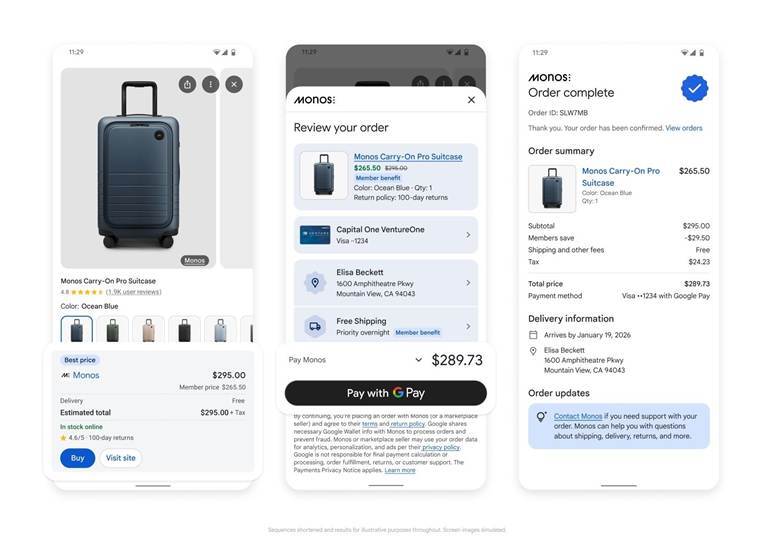
Image source: https://developers.googleblog.com/under-the-hood-universal-commerce-protocol-ucp/
Industry leaders including Shopify, Etsy and Target have collaborated with Google to help develop this standard, signalling strong ecosystem support.
Payment friction is one of the most significant barriers to purchase and is directly addressed by the UCP. The protocol uses tokenisation and secure digital wallets such as Google Pay, ensuring the AI agent never sees the user’s card details while the user retains final approval over each transaction.
Another pain point that is helped by the UCP is account fatigue. While online shopping, a user may find an item they want to purchase only to be faced with the request to make an online profile and enter personal contact details, often resulting in abandoned carts. With the UCP, a user can ask an AI assistant to order their usual skincare product. Instead of logging into the retailer’s website, remembering their password and re-entering shipping details, the AI agent completes the purchase securely within the chat after the user approves it. For consumers, this shifts shopping from a browsing experience to a confirmation experience.
For marketers, the UCP represents a shift from optimising websites for clicks to optimising systems for AI-driven transactions. As purchasing moves from browsing to prompting, brands will need to ensure their product data, pricing, inventory and payment integrations are structured for machine readability and instant fulfilment.
The UCP signals more than a new payment standard. It points to a structural shift in how products are discovered, evaluated and purchased. As AI agents increasingly mediate transactions, marketers will need to adapt across data, operations and measurement. Marketers should consider the following steps to facilitate this shift.
- Audit your product data for completeness and structure
- Ensure real-time pricing and inventory accuracy
- Strengthen fulfilment speed and reliability
- Prioritise ratings, reviews and trust signals
- Align marketing, ecommerce and operations teams
- Revisit attribution and performance measurement frameworks
The rise of agentic commerce may reduce traditional touchpoints, but it heightens the importance of trust, data accuracy and seamless infrastructure. Businesses that adapt early will be better positioned to capture demand in an increasingly AI-mediated shopping landscape.
Exclusively available to ADMA Members, the ADMA AI Toolkit is a marketer-ready guide on how to use AI effectively and responsibly – developed by industry for industry